
The article below was assigned to our summer 2026 intern, Rafael Khalil, and was written under the close supervision of our Team. Rafael explores the structural vulnerabilities of small and family-owned businesses, examining why so many fail to survive beyond their founders. Through a compelling analysis of how founders become trapped by their own indispensability, he highlights how total control ultimately prevents a business from outliving its creator. It is a timely and insightful piece that sheds light on succession challenges in economies like Cyprus, offering a thoughtful perspective on the heavy price of sole proprietorship and the difficult choice between going fast alone or going far with others. In a reflective and mature manner, Rafael wonders whether the ultimate trap of success is building something so dependent on yourself that it cannot survive your absence.
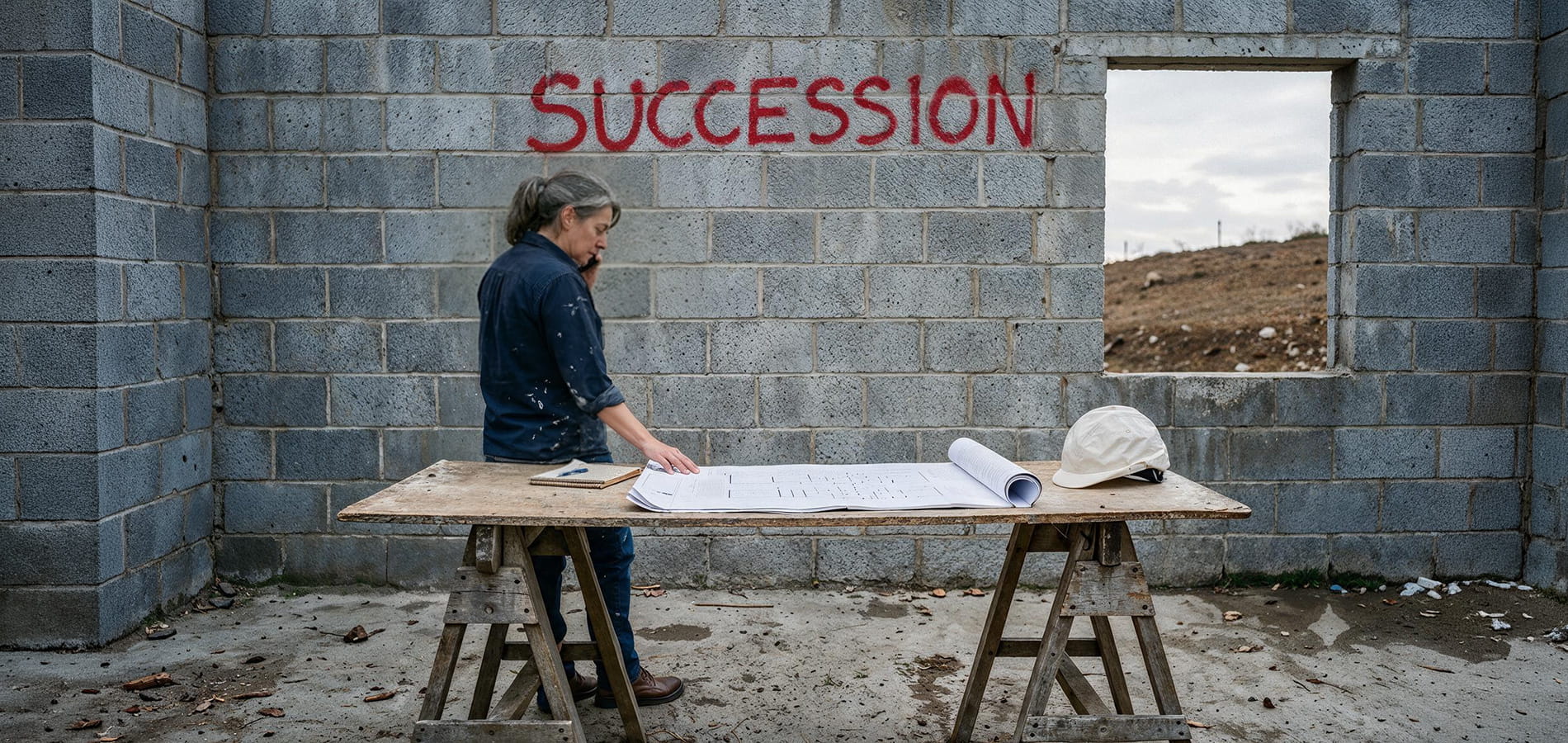
Maria arrives at the construction site at seven a.m. No one else in her business has even started driving to work, but she’s preparing to meet the painters and plasterers due on the site she’s building. One of them cancels, and she knows that this can cause a huge delay and require a change in the whole working schedule. She is already on the phone speaking to her next choice, knowing that he owes her a favour for the help she’s been providing for the last thirty years. And by eight thirty he confirms, as her employees start showing up for their usual shifts. Maria has no manual, no list of numbers, nothing written down that anyone else could open. But all she needs is the map of people that lives only in her head. She knows Aris from the city will ask for too much, and that Lorenzo will not answer at such a time anyway. Her ability to navigate this issue came from experience and practice. That only SHE can do it, is the reason the firm will probably die with her.
That morning was far from unusual; every job had run through her the same way for thirty years. She carries it all in her head: who to call, how much something should cost and how the week fits together. None of that is skill, it’s knowledge that could be transferred properly, in an orderly and structured way. The total control that built the firm is the same thing that guarantees it can’t outlive her. Anything she does can be taught, but a business that exists only inside one person’s head cannot be handed over. Only SHE manages jobs, speaks directly to clients, and knows how much to charge. She never taught it to others, never wrote it down, never had reason to. In wanting to handle everything, she doesn’t really own a business, she has a job.
When clients call, they expect an answer from Maria and would be insulted to be handed to an employee they’ve never heard of. To the outside world, she is the firm. Nothing moves when she isn’t there to move it. A pilot with no co-pilot flies the plane alone, since no one else has been trained to fly it. This plane flies fine, right up until the moment the pilot can’t fly it. Maria never had to train anyone else because for thirty years, she’s been alone in the cockpit. Picture Maria unreachable for two or three weeks. Could the business run? Nobody else knows how, or dares, to price the new sites coming in or to ring round for a painter when one drops out. The firm doesn’t slow down, it stops.
Maria’s case is not rare, and in Cyprus it is close to the rule. Around 125,000 businesses are registered on the island. 95% of them employ fewer than ten people, another 4% fewer than fifty, and more than 99% are small or very small and predominantly family owned. Between them they employ almost 60% of the workforce. According to KPMG Cyprus, fewer than three in ten of those businesses manage the handover to a second generation, and the global picture is no kinder: under 15% reach a third generation and fewer than 5% go beyond it. Selling instead of handing it on is not much of an escape, since advisers estimate that only two or three in ten small businesses put up for sale ever find a buyer. PwC’s global survey found that only about 30% of family businesses have a succession plan that is written down and shared with anyone, which leaves seven firms in ten with nothing on paper. Those seven run the way Maria’s firm runs, on what the founder happens to know.
None of this is because she never thought about it. Maria could help a new employee price a job, but teaching him means walking him through it, checking his numbers, and fixing his mistakes all while a client is waiting. That’s a week of her time and a risk to the job in hand, whereas doing it herself is quicker and ensures it’s correct, or so she thought, being ambitious. So, the sensible choice these past thirty years has been to do it herself. The teaching never happens because there is always a job that can’t wait for someone to learn. The trap that “just this once, I’ll do it myself” is correct on Tuesday and again on Wednesday but fatal when you add it up five hundred times. The clients who have known her for thirty years call only because it’s her. Handing them to an employee genuinely gives them a worse service and might lose them, so keeping them is the right call, every single time. But it is also why the firm loses its clients the day someone else picks up the phone. Handing over real tasks and decisions means they will make mistakes and be slower at the start, and on a live site those mistakes cost real money. That cost lands on Maria, in the same month the wages are due. It’s not that she won’t take it on, it’s that taking it on this month is never the rational call. She never saw a difference between doing the job brilliantly and owning a business, because in her hands, they’d always been the same thing. The instincts that trapped the firm are the exact instincts that built it. Her care, speed, pride, and loyalty are exactly why she has a firm at all. The cruelty of it is that there’s no version of her that builds this business and hands it on.
Some founders are exactly the version that Maria never became. Take this founder, who has the same ability as Maria, but who from early on made himself hand things away. He let employees answer the phone when clients called and watched them provide slightly worse service at first. These were the harder choices in the moment, the ones Maria declined. What differentiates him from Maria is that he chose to take smaller costs earlier rather than the largest cost later. The difference between the two isn’t skill or luck, it’s what each of them did with their own indispensability. Maria treated being irreplaceable as a prize, whereas he treated it as a fault to be worked out of the business. Making yourself replaceable means deliberately becoming less essential to the thing you built, but unfortunately almost nobody good enough to build it is willing to do that. He wasn’t smarter than Maria but wanted the firm to outlive him more than he wanted to be the reason it worked. He shared what he knew, patiently, split the duties, and built a structure that ran without him. That is the legacy. There is an old saying that if you want to go fast you go alone, and if you want to go far you go with others. Maria went fast. Only one of these firms will survive when their founders are no longer there.
Economists studied thousands of young firms, and found that when the founder died, the damage wasn’t a fumbled handover, it was the loss of the founder. For the larger firms in the study, the founder’s death cut sales by around 60%. A buyer pays for future cash flow, not past performance, so the founder is at once the firm’s single biggest asset and its single biggest risk. Think of Maria again in the morning, making that phone call to the person who owed her a favour. Maria is still the only person who can fly the plane, but one morning she won’t be in the seat.
Bibliography
Gerber, M.E. (1995). The E-Myth Revisited: Why Most Small Businesses Don’t Work and What to Do About It. HarperCollins.
Becker, S. O. and Hvide, H. K. (2022). Entrepreneur Death and Startup Performance. Review of Finance, 26(1), 163-185. https://academic.oup.com/rof/article/26/1/163/6281083
Ioannides, R., Managing Director and Head of Family Business, KPMG Cyprus, interviewed in Psara, S. (2025). Succession remains biggest challenge for Cyprus family firms. Cyprus Mail, 16 October 2025. https://cyprus-mail.com/2025/10/16/succession-remains-biggest-challenge-for-cyprus-family-firms
PwC (2021). Global Family Business Survey 2021. PricewaterhouseCoopers.
Exit Planning Institute. State of Owner Readiness. https://exit-planning-institute.org/state-of-owner-readiness
“THE REVITA TEAM”
Σημείωση: Τα άρθρα και τα δημοσιεύματα της εταιρείας μας, σκοπό έχουν να παραθέσουν στοιχεία για συγκεκριμένα θέματα καθώς και απόψεις που βασίζονται σε εμπειρία και γνώση που έχει αποκτηθεί. Απώτερος σκοπός μας είναι η επιμόρφωση των αναγνωστών στο σύνολο τους και όχι η παροχή συμβουλών για συγκεκριμένες περιπτώσεις. Για όλα τα προηγούμενα Newsletters της εταιρείας μας, μπορείτε να επισκεφτείτε την σελίδα μας στο Facebook, https://www.facebook.com/revitaconsult.

